Sunday, February 25, 2007

A Celtic Prayer


I bind unto myself today
the strong Name of the Trinity,
by invocation of the same,
the Three in One, and One in Three.

I bind this day to me forever,
by power of faith, Christ’s Incarnation;
his baptism in the Jordan river;
his death on cross for my salvation;
his bursting from the spiced tomb;
his riding up the heavenly way;
his coming at the day of doom:

Against the demon snares of sin,
the vice that gives temptation force,
the natural lusts that war within,
the hostile men that mar my course;
of few or many, far or nigh,
in every place, and in all hours
against their fierce hostility,
I bind to me these holy powers.

Christ be with me, Christ within me,
Christ behind me, Christ before me,
Christ beside me, Christ to win me,
Christ to comfort and restore me,
Christ beneath me, Christ above me,
Christ in quiet, Christ in danger,
Christ in hearts of all that love me,
Christ in mouth of friend and stranger.

Attributed to St. Patrick (Late 5th Century A.D.)

Saturday, February 24, 2007

Lighting Matches in a Light Bulb World- By Spencer Burke

When Jesus invited his followers to be “the light of the world,” what do you think went through the minds of the disciples? It only would have been natural for them to think in terms of the resources available in their day – spark, wood, oil, flame, and fire. But how much has changed since the first century? Even more radically, how much has changed in the last 150 years?

If Jesus were to pose the same invitation today, would we think in terms of matches or alternating current? Wood or filament? Oxygen or vacuum? Therein lies the tension.
We—the Church—have the job of being truth in an ever-changing world. Yet the reality is often that the church has over romanticized matches, wood, and oxygen.

The invitation of Jesus is not to remain captive to things that held true in the past, but to transcend, to evolve, to discover new ways of embodying the things that held true in the past. I find it fascinating that when we mapped the human genome, it was called genius. When we explored the mechanics of quantum physics, it was a step forward. When we democratized communication through the Internet, we called it revolutionary. Yet when we dream of a socially networked church, without walls or the one-hour event, it is perceived as the destructive to the Church.

Press here to read the full article along with comments from various readers

Mission to, in and from South Korea

As you know, South Korea is the country with the largest number of Presbyterians. The video below is an interesting depiction of some of the things that are going on there. What would have Calvin or Knox thought of that?

Wednesday, February 14, 2007

POST CHRISTIAN UK? ( A Times Online Report)

Thousands of churches face closure in ten years
Thousands of churches face closure, demolition or conversion in the next decade, leading to the demise of some branches of Christianity in Europe, according to experts.

In some parts of the country, former churches are being turned into centres of worship for other faiths. A disused Methodist chapel in Clitheroe on the edge of the Yorkshire Dales is the latest, destined to become a mosque for the town’s 300 Muslims.

There are more than 47,000 churches in Britain today, and 42 million people, more than 70 per cent of the population, consider themselves to be Christian. It sounds a lot, but behind the figures lies a story of decline in the country’s established religion.

Although the Pentecostal and Evangelical branches of Christianity are growing, worshippers often prefer modern, functional, warehouse-style buildings to the traditional neo-Gothic landscape of British ecclesiastical architecture.

Read the rest of the report

Wednesday, January 24, 2007

Any Hope for Mainline Churches? From Bill Easum

80-85% of all mainline and established churches are either on a plateau or in decline. This trend has been going on for thirty years (2000). Unless their is a miracle intervention from God little hope is seen.

Online Conversations

"I had an interesting exchange with a Lutheran lay person last night. He approached me and expressed some anger over the way his church just "sprang" some of that contemporary music on "them" in church on Sunday. I asked what his real concern about the music was and he stated that church is supposed to be "quiet." He spoke of tradition and the need to safeguard it at all costs. He gave the massacre at Columbine High School as an illustration of the consequences of failing to follow tradition. It was a very powerful conversation, which was amplified when I shared my own thoughts about church music and the need to test all tradition for its continued value to the church and the culture.

I had this picture in my mind of Jesus standing before the Pharisees and the Sadducees having a similar discussion. Luke tells us that Jesus was very regular in his attendance at the Synagogue. We know that He participated in the ritualistic reading of the scripture and the prayer life of the synagogue. We also know that there was something different about the way He read the scripture, as well as with the way He prayed. He followed the tradition in as far as it was helpful, but was not above adapting the old ways in new and more meaningful ways.

The synagogue was a place where religious people gathered every Sabbath to do religious things. They came in and sat down (probably in the same place every Sabbath), participated in the recitation of the Shema (a confession of faith in the one God), prayed, listened to readings from the Law and the Prophets, heard a sermon, and a benediction. And all of this went off like clockwork. There was no room for a young upstart carpenter to come in and throw a wrench into the works. The Pharisees made sure they were there to police it. Sound familiar?

Jesus was frequently in trouble with the gatekeepers in the synagogue. Does that sound familiar? He warned against the hypocrisy of those who paraded their righteousness in the synagogue. He warned against giving and praying in order to be seen and praised. He also rebuked those who sought the chief seats. As opposition increased, He warned His disciples of a future time when they would be persecuted in the synagogues; and as persecution developed, the believers were forced out of the synagogues. Sound familiar?

This is where my problem with the redevelopment effort begins. Don't get me wrong. I am one hundred percent behind the efforts of church redevelopment, but I am growing more and more skeptical that anything short of a total reinvention of the Church will have any long-term effect. When it came right down to it, Jesus never changed the synagogue. He never redeveloped it, but simply created something new with which to replace it.

Jesus was not satisfied with the model of the synagogue. He was not content to sit within its four walls waiting for people to come and make themselves welcome. He was not content with the idea that anyone who wanted to participate in the synagogue must first conform to look, dress and behave like all the other members of the synagogue community. Jesus did not limit his understanding of that community to the "contributing" members. Jesus went out to the people. I think He dressed like them. I think sometimes He smelled fishy like them. In short, Jesus went out and messed it up with them. In fact, Jesus was probably the most unreligious religious leader of all times.
Press here to read the rest of the article

Saturday, December 09, 2006

Wednesday, October 18, 2006

Immigrants' Creed

I believe in Almighty God, who guided the people in exile and in exodus, the God of Joseph in Egypt and Daniel in Babylon, the god of foreigners and immigrants.

I believe in Jesus Christ, a displaced Galilean, who was born away from his people and his home, who fled his country with his parents when his life was in danger, and returning to his own country suffered the oppression of the tyrant Pontius Pilate, the servant of a foreign power, who then was persecuted, beaten, and finally tortured, accused and condemned to death unjustly. But on the third day, this scorned Jesus rose from the dead, not as a foreigner but to offer us citizenship in heaven.

I believe in the Holy Spirit, the eternal immigrant from God's kingdom among us, who speaks all languages, lives in all countries, and reunites all races.

I believe that the church is the secure home for the foreigner and for all believers who constitute it, who speak the same language and have the same purpose.

I believe that the Communion of the Saints begins when we accept the diversity of the saints.

I believe in the forgiveness, which makes us all equal, and in the reconciliation, which identifies us more than does race, language or nationality.

I believe that in the Resurrection God will unite us as one people in which all are distinct and all are alike at the same time.

Beyond this world, I believe in Life Eternal in which no one will be an immigrant but all will be citizens of God's kingdom, which will never end.

Amen.
Rev. Jose Luis Casal- General Missioner- Trs Rios Presbytery. PC (USA)

Saturday, July 08, 2006

Prophets Of A Future Not Our Own (A Poem)

It helps now and then to step back and take a long view.
The Kingdom is not only beyond our efforts,
it is beyond our vision.

We accomplish in our lifetime only a fraction
of the magnificent enterprise that is God’s work.
Nothing we do is complete, which is another way of
saying that the kingdom always lies beyond us.


No statement says all that could be said.
No prayer fully expresses our faith. No confession
brings perfection, no pastoral visit brings wholeness.
No program accomplishes the Church’s mission.
No set of goals an objectives include everything.

This is what we are about. We plant the seeds that one
day will grow. We water the seeds already planted
knowing that they hold future promise.
We lay foundations that will need further development.
We provide yeast that produces effects
far beyond our capabilities.

We cannot do everything, and there is a sense of
liberation in realizing this.
This enables us to do something, and to do it very well.
It may be incomplete, but it is a beginning,
a step along the way, an opportunity for the Lord’s
grace to enter and do the rest.
We may never see the end results, but that is the
difference between the master builder and the worker.

We are workers, not master builders, ministers, not
messiahs. We are prophets of a future not our own.

Oscar Romero

Profetas de Un Futuro que No es Nuestro (Un Poema)

De vez en cuando, nos ayuda dar un paso atrás y contemplar el vasto panorama.
El Reino no solamente está más allá de nuestros esfuerzos, sino que trasciende nuestra visión.
Cumplimos en nuestra vida solamente una ínfima fracción
de la magnífica empresa que es la obra de Dios.
Nada de lo que hacemos es completo, lo cual es otra forma de decir
que el Reino siempre nos trasciende.
Ninguna declaración expresa todo lo que puede ser dicho.
Ninguna oración expresa totalmente nuestra Fe.
Ninguna confesión deviene en perfección.
Ningún programa lleva a cabo la misión de Cristo.
Ninguna meta o serie de objetivos incluye la totalidad.
Eso es lo que proponemos.
Plantamos las semillas que algún día brotarán.
Regamos las semillas que ya han sido plantadas,
sabiendo que contienen una promesa futura.
Echamos los cimientos que necesitarán posterior desarrollo.
Proveemos la levadura que produce efectos más allá de nuestras aptitudes.
No podemos hacer todo,
y al darnos cuenta de ello nos sentimos liberados.
Eso nos permite hacer algo y hacerlo muy bien.
Será incompleto pero es un comienzo,
un paso a lo largo del camino,
y una oportunidad para que la gracia del Señor aparezca y haga el resto.
Quizá nunca veremos los resultados finales.
Pero ahí está la diferencia entre el maestro de obras y el albañil.
Somos albañiles, no maestros de obra, ministros, pero no Mesías.
Somos los profetas de un futuro que no es el nuestro.

Oscar Romero

Saturday, June 17, 2006

Recent visit to Saddleback Church/ Visita a la Iglesia Saddleback

When God Comes Down

The narrative of the tower of Babel (Gen. 11) is often understood as the judgment of God over a proud human project: reaching the heavens through building up a tower. In order to stop that attempt God would scatter the people and confound their language. A closer look poses some deeper questions: In the Bible, more often than not, being scattered is a blessing rather than a curse. Such is the case of the children of Noah that after the flood and the subsequent covenant that God makes with them are scattered and re-populate the earth giving birth to different ethnicities and tongues (see Gen. 10:4, 20,31 and 32)

However, the inhabitants of the Babel are afraid of being scattered. They take refuge in their monolithic identity. Their efforts are directed toward only one city, one tower, one language. In such efforts the interaction with what is different disappears before the preponderance of what is familiar. What is foreign and different becomes undesirable.

Considering that the energy with which we can set ourselves to try to erect the towers of our group identity at the peril of all others, we can ask ourselves: Could it be that being scattered, more than being a curse would be God’s blessed way of liberating us from becoming self enclosed to the extent of turning into a rigid “insider’s club”. God “went down” and intervened in favor of diversity. It was only after the inhabitants were prevented from building a colossal “city” that they were able to begin building different and distinct “cities” in places where they were once again scattered.

The same type of openness and sending occurred in the day of Pentecost (Acts 2:5-12). God “comes down” upon those that were gathered in the upper room and they go out to speak in a way that others could understand them. With that initial impulse the apostles were set in a trajectory toward “the ends of the earth”. It would be only as they ventured into the foreign lands of the Mediterranean, Greece and Rome -as they heard their strange accents and observed their unfamiliar ways of living- that they became “good news”.

The openness that Spirit carves into the heart of the community of faith prevents it from being stuck in a set conception of God, itself and those around it. The Spirit is the only impulse that can turn our often self serving institutions into communities that live in the risky reality of being sent to transform and being transformed as they go. As soon as a society, organization or church begins using all its energies to hang on to a crystallized identity, vocabulary or system of thought, it begins to die. Before God comes down our rootedness becomes confinement, our apotheosis degenerates into sclerosis. When God comes down the apparent weakness of being scattered becomes our true strength. My confidence is that the living presence of the Spirit promised by Jesus to his Church will continue to give us the courage to be the people of God scattered beyond our walls and among the often unfamiliar realities and territories of today’s society.

Saturday, March 11, 2006

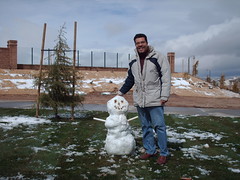
Nieve Marzo 06 026


Nieve Marzo 06 026
Originally uploaded by juanjsarmiento.
Ayer cayo nieve el Sur de California. Que cosa tan rara!